Contents
THE INTEGRATED STORY IN GRADES 1–3
Integrated topics in the order the story unfolds
Grade 1: The universe; the Earth; location on the globe, climate/weather; explorers; Estonian nature and people; homeland and nationhood; neighbouring countries; preparing for settlement, the settlers' voyage to the island, landing, shelter, water, growing food, foraging.
Grade 2: Home, food (agriculture), fishing, energy, culture, law-making, finance, industry, international relations, languages, export, import.
Grade 3: Education, healthcare, science, communication, government, taxes, services, advertising, the arts, the environment, religion.
The integrated story that shapes learning in Grade 1
Who are we humans, anyway? If an alien came from outer space, how would we explain our life to it?
We live in the Milky Way galaxy, in the Solar System. A number of planets orbit our star, and one of them is the Earth. People have settled every habitable place on Earth, because they have always looked for a better life, and adventurous explorers have been the first to reach unsettled lands. There are also places on Earth where no one lives, because the climate is not fit for living.
Estonia lies in the northern hemisphere of the Earth, on the shores of the Baltic Sea. We are Estonians, we speak Estonian and we have our own culture. Estonia has many forests, untouched nature, lakes, rivers and islands. Our neighbours are Latvia, Russia, Finland and Sweden. People migrated to the lands of Estonia after the end of the Ice Age. People from Estonia, too, have set out to look for undiscovered lands.
We, too, have a voyage of discovery ahead of us, to find a land where we can build a good life for ourselves. What do we need to set off on a voyage of discovery? The journey has to be thought through and planned carefully in advance. At last the day comes when we set off! Soon we find an island that looks fit to live on and where no people have settled yet. Now we have to settle in for the first time and find shelter and food.
AN EXAMPLE OF A LEARNING DAY
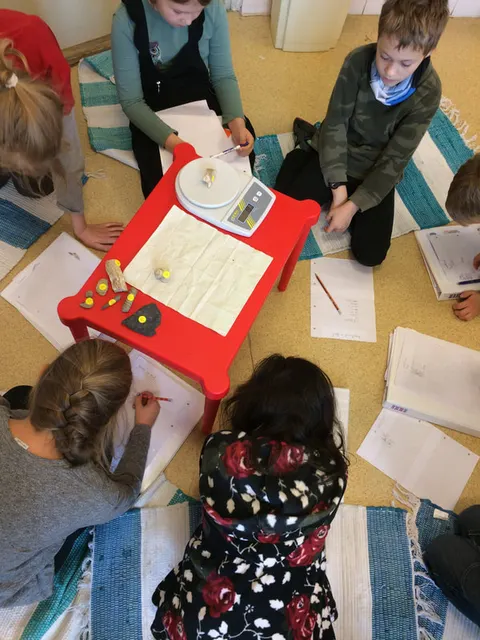
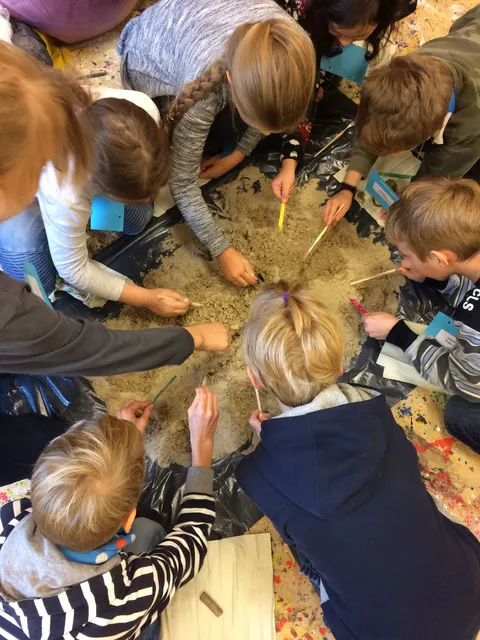
Here is an example of a day when the pupils played archaeologists, covering Estonian, science, maths and art all within this one topic. There was an archaeological dig, the children wrote a magazine story about the fossil they had found, did calculations, and held an archaeologists' conference where they presented their finds. They also weighed fossils and modelled their own imaginary fossil out of clay.
| LESSON 1 | Lesson topic: Fossils
Lesson goals: – I start a sentence with a capital letter and end it with a full stop or question mark. – I write a short story on a given topic, based on the questions provided. – I can form questions using question words. – I explain why the work of archaeologists matters. 1. Tuning in A pat, a hug – how can you hug yourself? I arrive here, in this moment – a minute of silence, feel the soles of your feet, your toes. What new thing did I learn at school yesterday? I show a rock with a fossil inside – what is today's topic?2. Understanding the meaning / learning A film about archaeology. The concepts “past”, “present”, “future” – explanation and discussion. Write the questions in your notebook and find the answers in the film. Today we are archaeologists – what tools do we need? We are on a dig, everyone wears a name tag. Find a fossil (the fossils are in sand on a sheet of plastic). We write a magazine science story about our find. Choose a magazine and look at it while writing the story. Questions for each pupil that need to be used in the text. 3. ReflectionDiscussion. Why is the work of archaeologists important? What was your most important task as an archaeologist?Practise presenting your made-up text at the archaeologists' conference. |
| LESSON 2 | Lesson topic: Fossils Lesson goals: 1. Tuning inTHE HAPPINESS JAR – emotions – how do I feel today, how do feelings arise, why do joy and anger arise, how do I act next? An emotions game. 2. Understanding the meaning / learning Problems (within 20) – glued onto squared paper. (E.g.: Fifteen people were invited to the archaeologists' conference. Three of them said they could not come. One day before the presentations, one archaeologist called to say he would come to the conference after all. How many archaeologists came to the conference?) We write the sums on paper. Make up a problem of your own. 3. ReflectionWrite the most important words about the topic of fossils on a sheet of paper. |
| LESSON 3 | Lesson topic: Weighing Lesson goals: 1. Tuning inPictures of different kinds of scales. 2. Understanding the meaning / learningWeighing the fossils – we record the results in a table – measuring instrument: scales, unit: g. We compare lighter fossils (smaller mass) and heavier ones (greater mass). “Is lighter than”, “Is heavier than”. 3. ReflectionDiscussion: Why is weighing important and necessary? |
Project-based learning
Project-based learning is used throughout Loova Tuleviku Kool.
A project is a longer, clearly defined form of learning with a concrete result. The result of a project should be genuinely useful to someone. An ideal project tackles real-life problems in the same way as happens in real life. Projects allow for deeper integration of subjects.